
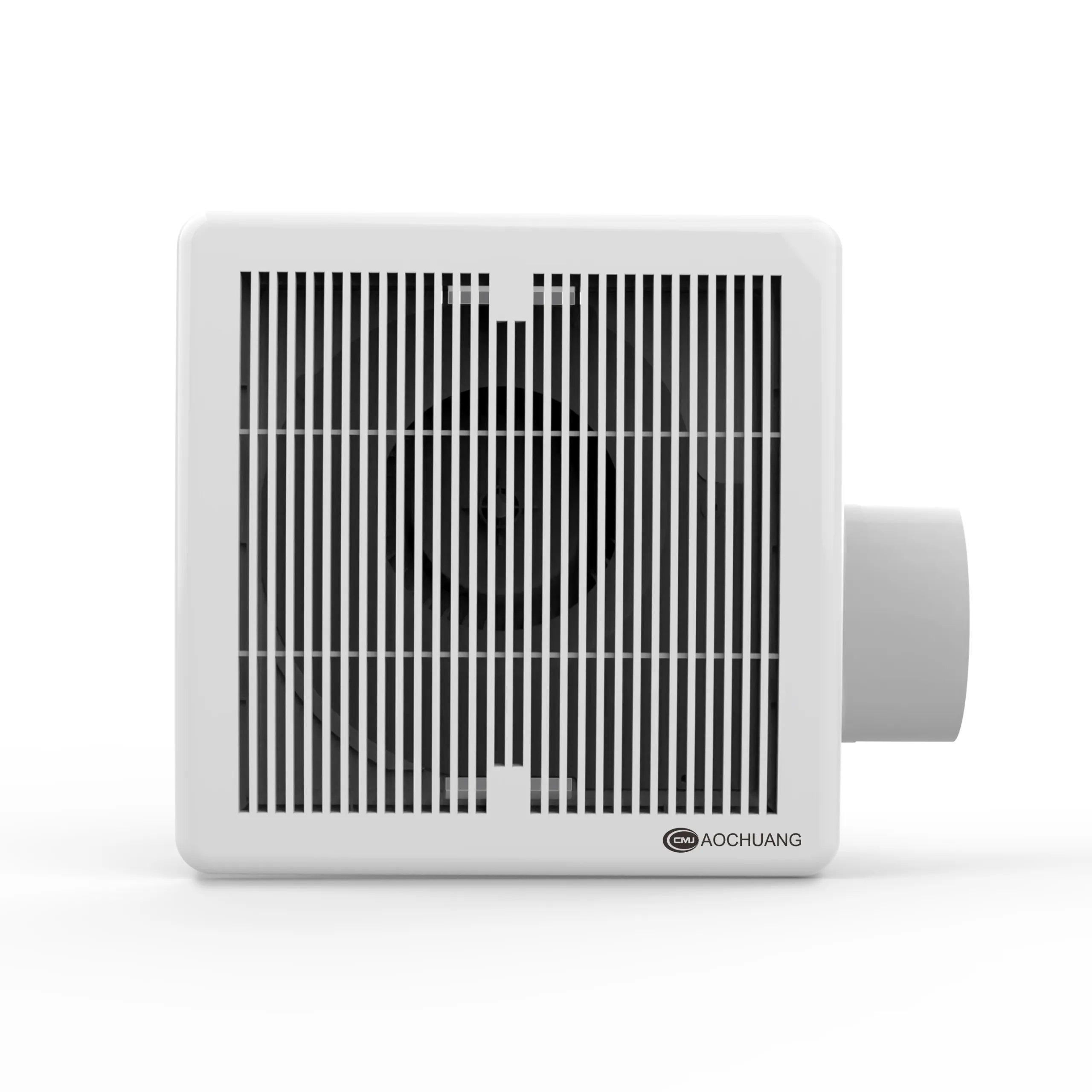
Choosing a bathroom exhaust fan involves balancing airflow, operating noise, power consumption and installation space. Aochuang’s ceiling-mounted ventilation range offers three models with published airflow figures of 120, 150 and 180 m³/h, paired with power ratings of 9, 10 and 11 W.
The BPT10-14D, BPT10-24D and BPT10-34D combine a brushless DC motor, a square intake grille and a side outlet for duct connection. They give homeowners, installers and ventilation buyers three configurations to compare when planning a ducted bathroom exhaust system.
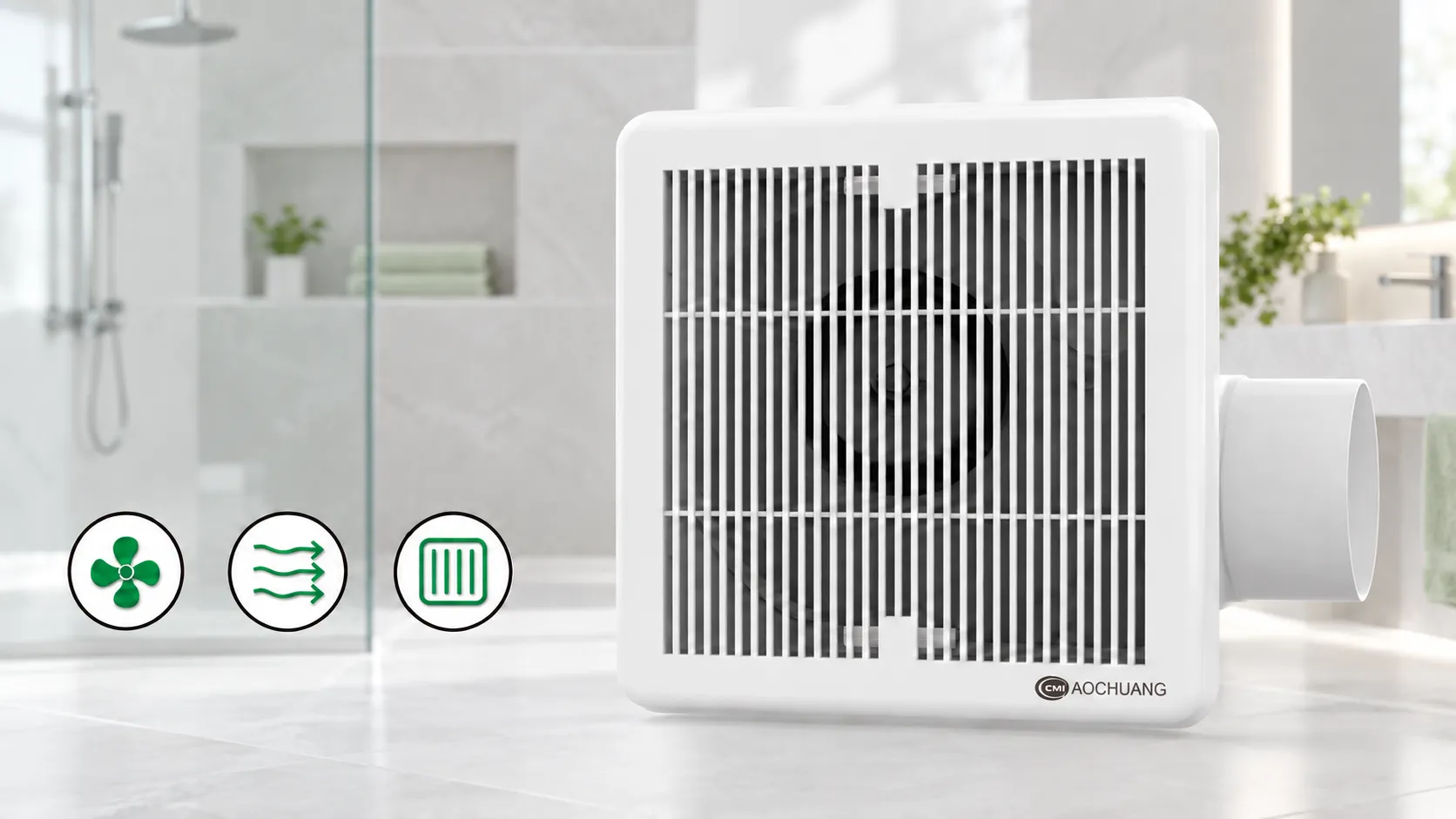
Technical Specifications
| Specification | BPT10-14D | BPT10-24D | BPT10-34D |
|---|---|---|---|
| Published airflow | 120 m³/h | 150 m³/h | 180 m³/h |
| Approximate airflow in CFM* | 71 | 88 | 106 |
| Power | 9 W | 10 W | 11 W |
| Motor speed | 1,000 RPM | 850 RPM | 810 RPM |
| Published noise level | 40 dB(A) | 41 dB(A) | 42 dB(A) |
| Panel dimensions | 258 × 258 mm | 280 × 280 mm | 340 × 340 mm |
| Housing dimensions | 202 × 202 × 130 mm | 224 × 224 × 134 mm | 253 × 253 × 139 mm |
| Ceiling cutout | 210 × 210 mm | 230 × 230 mm | 260 × 260 mm |
For example, the BPT10-24D pairs a listed airflow of 150 m³/h with a 230 × 230 mm ceiling cutout. Moving to the BPT10-34D increases the published airflow to 180 m³/h, but also requires a larger opening and housing space.
This makes installation fit an essential part of model selection, particularly when replacing an existing fan.
Brushless DC Motor with 9–11 W Power Ratings
Aochuang identifies a brushless DC motor as a core feature of this range. The published power figures allow buyers to make a straightforward estimate of electricity use.
For illustration, a 10 W fan operating for two hours per day would use:
0.010 kW × 2 hours × 365 days = 7.3 kWh per year
Multiply that figure by the local electricity tariff to estimate the corresponding energy cost. This is a calculation based on the stated power and assumed operating time; actual consumption depends on the supplied unit and its use.
When comparing products, assess power consumption alongside airflow at equivalent test conditions. A lower wattage alone does not establish whether a fan can deliver the ventilation needed by a particular installation.
A Quiet Bathroom Exhaust Fan with Stated Sound Figures
The three models have manufacturer-listed noise levels ranging from 40 to 42 dB(A). These figures provide a more useful starting point than a general “silent fan” description.
For projects where sound is a major consideration, request the measurement method, distance and operating conditions. Compare alternative fans using equivalent test data, and consider a sample evaluation in a representative installation.
The published figures describe the manufacturer’s specifications; they do not guarantee the sound level that will be experienced in every bathroom.
ABS Construction and Backdraft Prevention
The product information describes flame-retardant ABS construction and an anti-UV treatment on the panel. The white square grille provides a simple ceiling finish, while the housing and duct connection sit above the visible panel.
A backdraft-prevention feature is also listed, with an outlet flap shown in the product imagery. Its purpose is to help limit reverse airflow through the exhaust connection.
For procurement documents, request the relevant material classification and damper details. A flame-retardant material description should not be treated as evidence that the complete fan is a fire-rated ventilation assembly.
How to Choose the Right Model
Match airflow to the room and duct system
Start with the bathroom’s ventilation requirement, then review the planned duct route. Duct length, bends, materials and the exterior termination all contribute to airflow resistance. The Home Ventilating Institute identifies these factors as relevant to achieving the intended exhaust rate. HVI ventilation guidance
Ask for airflow-versus-pressure data when the duct route is long or includes several bends. The largest number in a specification table is only one part of the selection decision.
Check the cutout, housing and panel separately
Each dimension answers a different installation question:
- Cutout dimensions determine the required ceiling opening.
- Housing dimensions show the space occupied by the fan body.
- Panel dimensions indicate the visible coverage around the opening.
The published housing heights range from 130 to 139 mm. Additional room may be needed for connections, mounting and maintenance access.
The specification image also uses nominal 8-, 10- and 12-inch size labels. These should not be assumed to represent duct outlet diameters. Confirm the connection size from the installation drawing.
Confirm electrical and installation details
Before ordering, obtain the voltage, frequency, wiring requirements and compatible controls for the exact model. The product page’s text fields do not provide a confirmed voltage specification.
For bathroom placement, also check the installation manual and applicable moisture-protection information. This helps the installer determine where the selected unit can be fitted.
FAQ
Q1:Which model has the highest published airflow?
The BPT10-34D has the highest listed airflow in this range at 180 m³/h, with an 11 W power figure and a 260 × 260 mm ceiling cutout.
Q2:Which model uses a 230 × 230 mm ceiling opening?
The BPT10-24D. Its published panel size is 280 × 280 mm, and its housing measures 224 × 224 × 134 mm.
Q3:Does this range use a DC motor?
Yes. Aochuang’s product material identifies a brushless DC motor. Confirm the available control configuration if adjustable operation is required for the project.
Q4:Does the fan include backdraft prevention?
The manufacturer lists a backdraft-prevention feature and shows a flap at the duct outlet. Request the installation instructions to check its operation and required clearances.
Request Specifications for Your Ventilation Project
To compare the BPT10-14D, BPT10-24D and BPT10-34D for your project, send Aochuang your required airflow, ceiling opening, available ceiling space and duct layout.
Request the current model datasheet, installation drawing and electrical specifications to select a fan that fits both the room’s ventilation needs and the installation conditions.

Reviews
There are no reviews yet.